
What Is PUE? A Power Usage Effectiveness Guide
Power Usage Effectiveness is the go-to metric for data center energy efficiency. Here’s why it matters and how operators use it.
By Nate Bruns
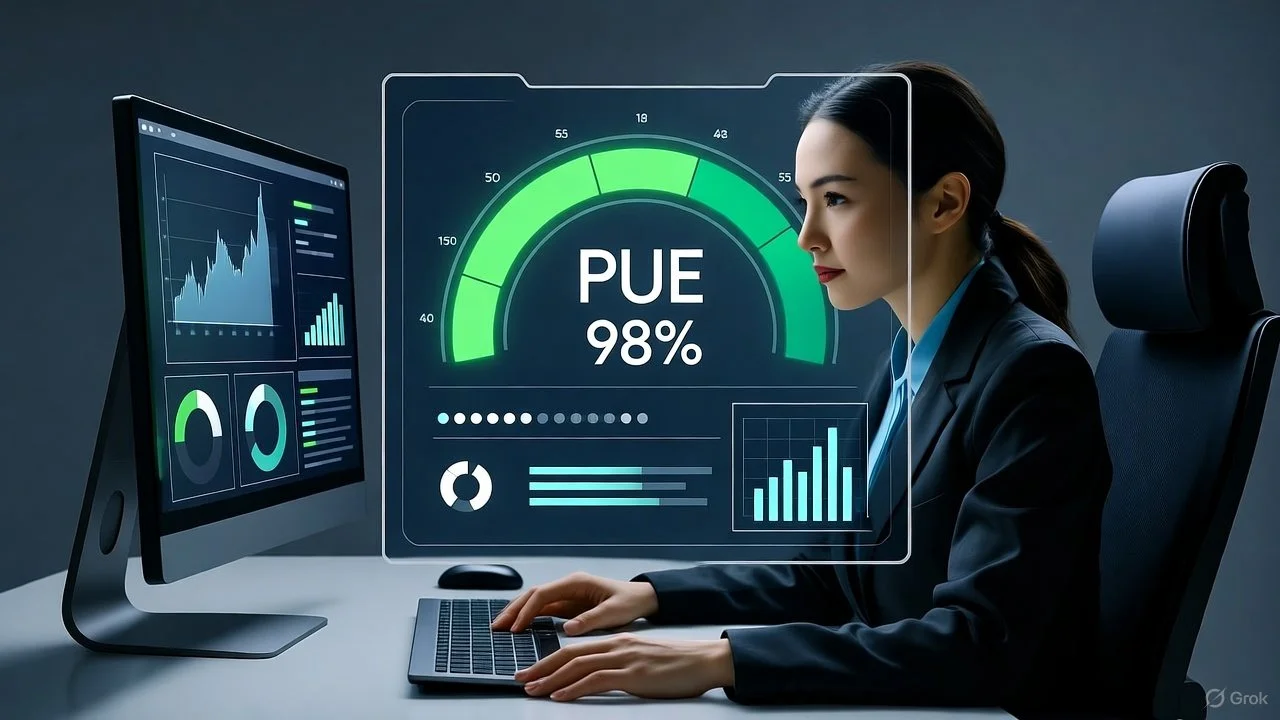
Power Usage Effectiveness (PUE) is the go-to metric for measuring how efficiently a data center uses energy. Operators rely on it because it directly connects infrastructure efficiency to business performance.
PUE = Total Facility Power ÷ IT Equipment Power. A PUE of 1.0 means all energy goes directly to computing (perfect efficiency). Higher numbers reveal power lost to cooling, lighting, and UPS conversion.
Why PUE matters
1. A clear measure of efficiency. PUE captures, in a single number, how much of your power actually reaches compute versus overhead.
2. Cost control at scale. Energy is one of the largest operating costs in a data center. Even a small improvement, say 1.6 to 1.4, can save millions annually in hyperscale environments.
3. Benchmarking. PUE lets operators compare sites, identify underperformers, and track the impact of upgrades like efficient cooling or UPS modernization.
4. Capacity planning. Understanding IT load versus overhead helps optimize design and plan expansions without overspending on power and cooling.
5. ESG reporting. Hyperscalers and colocation providers publish PUE in sustainability reports to demonstrate progress toward net-zero goals.
6. Regulatory and market pressure. Governments and customers demand transparency on energy use, and a low PUE is a competitive differentiator.
7. Identifying inefficiency. A poor PUE often points to wasteful infrastructure, legacy CRACs, idle UPS, or bad airflow, and helps justify decommissioning or modernization projects.
PUE matters because it ties energy use to efficiency, cost, sustainability, and competitiveness. It’s the single metric that tells operators how much of their power is actually doing useful work.
Related resources
Decommissioning Idle "Zombie" Servers
Idle servers draw power and demand cooling without doing useful work. Removing them is one of the fastest ways to improve PUE.
Read more →
How to Improve Data Center PUE
A breakdown of the non-IT infrastructure and underutilized assets operators can decommission or consolidate to improve PUE.
Read more →